
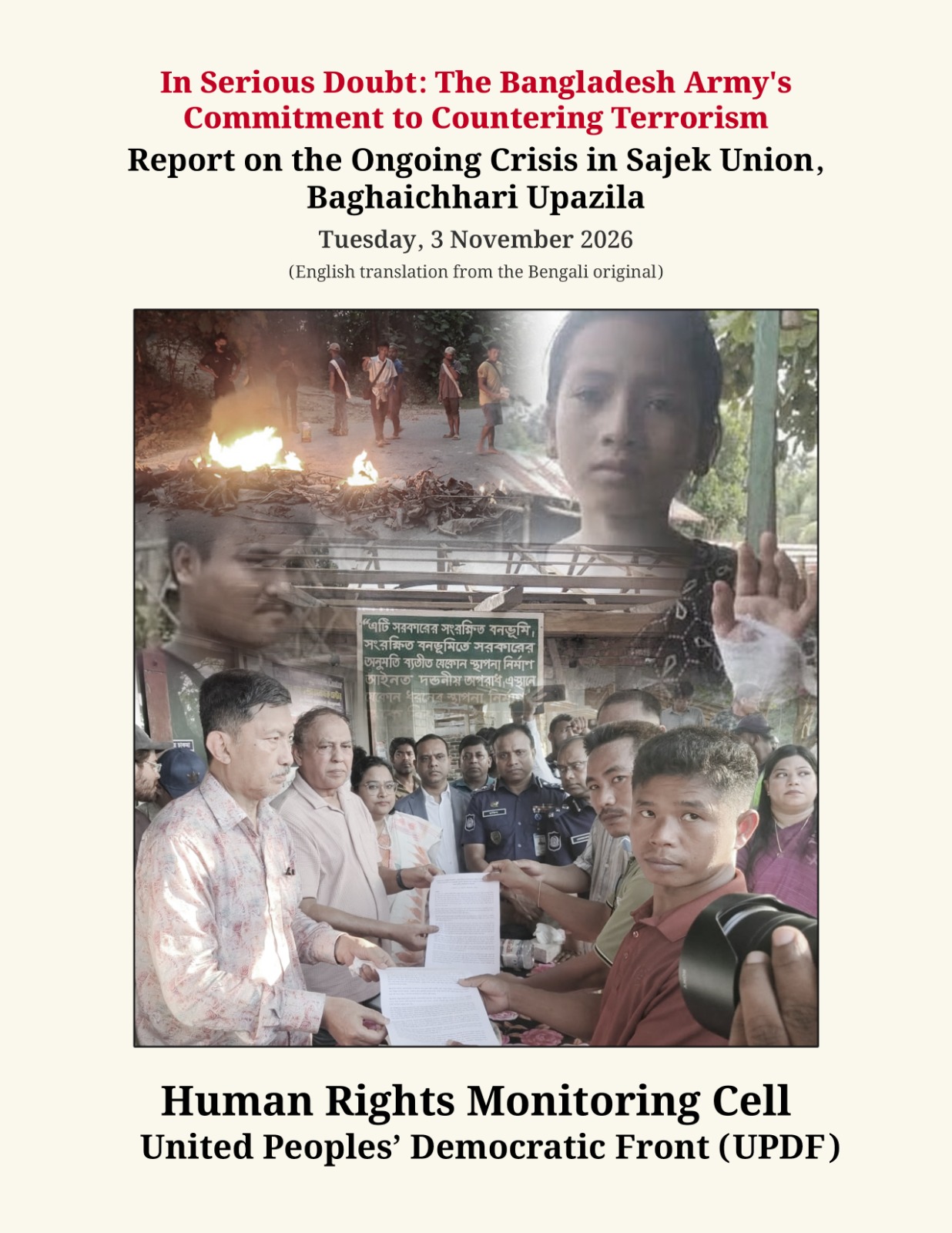
In Serious Doubt: The Bangladesh Army’s Commitment to Countering Terrorism
Report on the Ongoing Crisis in Sajek Union, Baghaichhari Upazila, Rangamati District, and Some Recommendations
Tuesday, 3 November 2026
(English translation from the Bengali original)
Introduction
The events that took place in Sajek Union of Baghaichhari Upazila, Rangamati, between August and October 2026 have created a deep humanitarian, administrative and political crisis. Sajek is outwardly known as a charming natural tourist destination, but behind that image lies a long history of continuing marginalisation of the local Pahari or Jumma communities, pervasive military control, and violations of basic human rights. In 2008 and 2010, the army together with settlers carried out communal attacks on Paharis in Sajek. Hundreds of homes were burned to ashes, and several Paharis were killed by army gunfire.
Although the overall role of the security forces in the Chittagong Hill Tracts has long been debated, this report confines itself to a few specific issues. The particular incidents that took place in Sajek between August and October 2026 show that, under the pretext of so-called counter-terrorism, ordinary people are being subjected to repression through the direct and indirect collusion of the state security forces and the armed group of the Santu Larma faction of the Jana Samhati Samiti (JSS). As a result, serious questions have arisen about the real role of the Bangladesh Army deployed in the Hill Tracts.
The main aim of this report is to present an objective picture of these human rights violations in Sajek, and to examine the specific role of the state and the military in order to seek an answer to the central question: Is the Bangladesh Army really working to counter terrorism?
Chronology of Events
A) The abduction of Ferdous Chakma and the army’s relationship with the armed wing of the JSS Santu Group
The abduction of Ferdous Chakma on 3 August 2026 is a clear example of how ordinary people’s lives in a remote area like the Sajek Valley in the Chittagong Hill Tracts are held hostage by armed terror. Analysing this one incident makes it plain how a disciplined government force and the armed group JSS, led by Santu Larma, Chairman of the Chittagong Hill Tracts Regional Council, are jointly oppressing the ordinary people of Sajek.

On 3 August 2026, a group of armed terrorists of the Jana Samhati Samiti (JSS Santu Group) arrived on motorcycles at the well-known “Same Place Restaurant” in Sajek, ambushed Ferdous Chakma, forcibly abducted him, and took him toward Udaipur. It should be noted that the Udaipur and Kanglak area is run entirely under the exclusive control of the armed cadres of the JSS Santu Group.
On 7 August, at around 10 a.m., Ferdous Chakma’s wife Jatana Chakma and his father-in-law Moni Chakma were on their way to the police station to file a case when two soldiers from the Field Security branch of the Baghaihat Army Zone, Md. Humayun and Md. Jasim, stopped them at Ujo Bazar and prevented them from going to the police station. Soldier Humayun assured the abductee’s wife that her husband was safe and was at home. When Jatana Chakma asked for proof, Humayun called the JSS armed commander Bikram Chakma from his own mobile phone. He scolded Bikram in a threatening tone: “You are living on my money, under my protection, and yet you did not tell me that you had abducted Ferdous Chakma?”
From the other end of the line, JSS commander Bikram Chakma admitted the offence, saying: “Sir! Sir! We picked him up. Ferdous is with me.” This conversation clearly proves that an intelligence member of the Baghaihat Army Zone is in regular contact with an armed commander of the JSS, and that these criminal activities take place in Sajek with their knowledge.
When the abductee’s wife broke down in tears, soldier Humayun pressured her not to file a case. He gave her the false assurance that her husband would be returned home within a day or two, and forced her to go home. When she later protested, Md. Humayun arrogantly said, “I didn’t come to this job to rescue your husband!”
About an hour later, some pro-army news portals and social media channels circulated the claim that the army had rescued Ferdous Chakma from his own home. But the truth behind the scenes is that this was not a rescue operation at all; it was a staged drama by the JSS and the army. On the army’s secret instructions, JSS terrorists kept Ferdous seated in the Chhoto Kanglak area, and soldiers went there and took photographs of themselves dramatically “rescuing” him, which gave the abducting terrorists complete impunity. Hardly had the effects of this drama faded when Poribartan Chakma, an armed member of the JSS, told the abductee’s father-in-law that Ferdous would not be returning to Baghaihat, and that he had been placed under “area confinement” under the JSS’s strict surveillance. The JSS even took the mobile phones of the entire family into its own custody.
This incident highlights several points: first, the insecurity of ordinary people in Sajek; second, an understanding between the state forces and the armed members of the JSS Santu Larma group; and third, the obstacles to seeking legal redress and the impunity of the criminals. In short, this incident presents a cruel picture of the appalling human rights violations in Sajek, where an ordinary citizen who falls victim to a crime and tries to seek legal help is obstructed by the state security forces themselves.
B) Sajek College and the army’s role
The establishment of “Sajek College” is one example of how the dream of higher education for poor and disadvantaged students in the Sajek area has repeatedly met obstruction from the state administration and military power.

In 2024, ordinary residents of Sajek took the initiative to establish the college entirely with their own funds. But from the very start of construction, the Forest Department and the army began obstructing it on various pretexts. As part of this, on 13 June 2025, Forest Department personnel put up a signboard on the premises of the college under construction, describing the land as reserved forest and stating that building any structure without permission was a punishable offence.
Yet the reality of Sajek is different. In the same Sajek where Pahari indigenous people have been forcibly evicted from their homesteads to build huge commercial resorts and luxury cottages, the Forest Department shows no legal objection to those. Around 2020, a large “Darus Salam Jame Mosque” was also built through a joint initiative of the Bangladesh Army and the Rangamati Hill District Council, even though it does not reflect the local demographics of the Sajek area. While the reserved forest law was no obstacle for commercial resorts or the mosque, the Forest Department suddenly became extremely active and strict when it came to building a college where the children of poor people could study.
After overcoming many obstacles, on 10 August this year, when the college clerical staff and teachers made a final effort to start classes, the army, police and Forest Department turned up together and obstructed them. Heavy pressure was applied to install either Major Md. Salman Siddique, Second-in-Command (2IC) of the Baghaihat Army Zone, or the Zone Commander as chairman of the Sajek College governing board. Their message was clear: an army officer must be made chairman of the board, otherwise classes would not be allowed to continue, and a compensation suit of Tk 5 million would be filed against local dignitaries and elders, including Atulal Chakma, Chairman of Sajek Union Parishad.
Later, when local representatives approached the Officer-in-Charge (OC), OC Tofazzal told them plainly that the police have no power in the Chittagong Hill Tracts. He advised that, for the sake of ordinary people, it would be wise to reach an understanding with the army. In other words, the civil administration there has no independent standing, and military authority has the final say. Even so, that day the local people courageously put specific arguments before the police and the Forest Department, and they were forced to retreat. But even after that, the invisible pressure and harassment from the military zone around the college continued.
C) Bringing the armed group JSS in under army patronage
Evidence of how an armed group can move freely under the nose of the administration in the Sajek tourist area emerged in late August 2026. According to local sources, on 31 August, an armed group of about 40 to 45 members of the JSS Santu Group arrived in jeeps and openly took up positions in the Bridgepara, Nuopara, and Shibpara areas. These locations are notably close to the Machalong Army Camp and lie directly between two military outposts.
Although the armed terrorists remained unhindered within just one to three miles of the Machalong Army Camp, no action was taken against them by the soldiers on 1 September. On the contrary, food, water and necessary supplies were provided to them. Local people strongly allege that this armed group has been brought and stationed in Sajek in order to stop the initiative to establish Sajek College and to suppress the local people’s legitimate movement.
D) The wounding of Kosmita Tripura
The tragic picture of how insecure ordinary people’s lives are in the remote hilly settlements of the Sajek Valley emerged in the incident of 29 September 2026. That morning, in the Machalong Noapara area of Sajek, a group of armed terrorists of the JSS Santu Group suddenly began firing indiscriminate bursts without any prior provocation.

During this reckless firing, eight-year-old Kosmita Tripura, daughter of Ulendra Tripura, a resident of Mandirchhara Village No. 1 near Machalong, was inside her home. A bullet fired by the terrorists struck her left hand and seriously injured her. Her family members took her to a local pharmacy, where a bullet was removed from her mangled hand with the help of a medical practitioner. The fact that an innocent child, sitting inside her own home, was wounded by armed terrorists in this way caused intense concern and anger throughout Sajek.
What is worrying is that the Machalong Army Camp and a security forces presence are located a short distance from the area where these terrorists fired. Even though this armed rampage took place so close to the camp, the law enforcement forces took no immediate action. This inaction has given rise to deep suspicion among local people that, without the silent consent or support of the state forces, the terrorists would not have dared to carry out such barbaric acts.
E) Attacks on jhum cultivators, threats, and seizure of mobile phones
On 10 October 2026, armed terrorists of the JSS Santu Group fired indiscriminately on ordinary jhum cultivators in the Mandirchhara area of Machalong, Sajek. That morning, Chitto Chakma (39), a resident of the Thalkumbho area of Machalong, and his wife Chipudi Chakma (36), went to harvest rice in their jhum field when the terrorists opened fire on them in bursts without any prior warning. The couple barely managed to escape with their lives. Local people believe that when terrorists enter a new area, they fire like this without provocation in order to instil fear in ordinary people. In addition, JSS terrorists in the Bhuyochhari, Lambabak and Ujjengchhari areas of Sajek descended on ordinary people and forcibly seized their personal mobile phones. The terrorists threatened locals that anyone found to have even the slightest evidence of contact with the UPDF or any other party on their mobile phone would be brutally killed. This free operation of armed terrorists under the very nose of the state’s law enforcement forces is an extreme violation of human rights.
F) House searches and arson
On 14 August 2026, an army team suddenly raided Nanglamara village in the Gangaram area of Sajek, Rangamati. Nineteen soldiers from the Gangaram Tiger Tila Camp surrounded the house of village resident Bakul Chakma without any reason or prior notice. By asking irrelevant questions such as “Where is the UPDF holding its meeting?”, the soldiers left the innocent family mentally shattered.
Later, on 7 September, the army carried out a larger-scale crackdown in the Machalong area of Sajek. At around 12 noon that day, a large number of soldiers entered Machalong Bazar from the Baghaihat Zone in four large vehicles and nine pickup vans. The soldiers seized two young men, Sohel Chakma and Jiko Chakma, from in front of the bridge, took them away and physically tortured them. The soldiers then raided Shantipara village in Machalong and surrounded the house of Babu Chakma. When the soldiers began surrounding several more houses to search them, brave women of the area gathered and put up strong resistance, and the soldiers were forced to retreat.
However, the repression of ordinary people went beyond all limits on 13 October 2026. That morning, serious allegations arose against the army of burning down the dwelling of an ordinary man named Miye Ranjan Chakma in the Chhilyatali area of Machalong in Sajek Union. According to local sources, ever since JSS terrorists came from Udaipur and Kanglak under army guard on 31 August, Miye Ranjan Chakma had been forced to leave his home and move elsewhere for his safety. For more than a month he had been unable to return home. In the meantime, on the morning of 13 October, army personnel, in the name of an operation in the area, fired blank shots and set fire to his empty dwelling beside the Chhilyatali Kuthir, burning it down.
G) The Sajek people’s movement, ultimatum and road blockade programme
Protesting the misdeeds of the armed JSS Santu Group terrorists and the harassment by soldiers, local people launched an intense movement under the leadership of the Sajek Karbari Association and the Sajek Gono Odhikar Rokkha Committee (Sajek People’s Rights Protection Committee).
First demonstration (1 October): Following the shooting of the child Kosmita Tripura, a huge rally and march were held on 1 October 2026 at Ujo Bazar in Sajek to protest the security forces’ backing and patronage of the armed group causing unrest, and demanding strict action against them. Ordinary people took part spontaneously in this programme, jointly organised by the Sajek Gono Odhikar Rokkha Committee and the Sajek Karbari Association. At the rally, strong protest was voiced over the shooting of Kosmita Tripura, and the armed members of the JSS Santu Group were held responsible.
After the rally, JSS Santu Group armed commanders Bikram Chakma and Asim Priya Chakma targeted the local elders and leaders who had spoken at the rally and threatened them with death by mobile phone. It was said that Babudhan Chakma, convener of the Sajek Gono Odhikar Rokkha Committee, together with Milon Chakma, Karbari Jyotilal Chakma and Bijoy Kanti Chakma, had been put on a “hit list”, and that they would be killed unless they cut their ties with the UPDF.
Second demonstration and 48-hour ultimatum (8 October): As armed members of the JSS Santu Group continued to threaten various elders and karbaris of Sajek for joining the 1 October rally, a massive demonstration was organised on 8 October “protesting the presence of armed JSS Santu Group terrorists in Sajek under the backing and patronage of the security forces and their death threats against ordinary people, and demanding the removal of the armed terrorists within 48 hours.” More than 3,000 ordinary people took part spontaneously. The rally announced that if the administration failed to meet the demand within 48 hours, an indefinite blockade would begin on 11 October.

On the night of 10 October, the day before the blockade, about 50–60 soldiers from the Baghaihat Army Zone raided Ujo Bazar in Sajek. They forced their way into the homes and shops of Babudhan Chakma, Milon Chakma and Bijoy Kanti Chakma, subjected them to widespread harassment in the name of searching, and seized four hand-held microphones that had been kept for use at the protest rally.
Despite all this intimidation, the people of Sajek began a total, indefinite road blockade on the Sajek tourist road from 11 October. During the blockade, in the afternoon, senior military and civil administration officials came to Ujo Bazar, held discussions with the protesters, and asked them to lift the blockade. The people of Sajek put forward three conditions: first, all armed terrorists of the JSS Santu Group must be removed from Sajek within 48 hours; second, the terrorists must not issue any death threats; and third, the army administration must not search ordinary people’s homes at night. Because the administration gave a specific commitment to implement these demands within two days, the blockade was declared suspended for only 48 hours.

Second round of blockade: Even after the 48-hour deadline passed, the administration failed to take any effective step to fulfil the three conditions it had accepted, and on top of that, on 13 October the dwelling of Miye Ranjan Chakma in the Machalong Chhilyatali area was burned down. In this context, the Sajek Karbari Association and the Sajek Gono Odhikar Rokkha Committee announced a second round of continuous road blockade from 15 October.
However, during the blockade on 15 October, when the Baghaihat and Machalong Bazar Puja Celebration Committee requested that respect be shown to the Sharodiyo Durga festival, the two organisations announced that the blockade would be suspended from 16 to 21 October. At the same time, they warned that if the administration did not implement the demands within this period, a tougher programme would be announced.
Third round of blockade and the army’s brutal attack (22 October): Because the administration failed to meet the Sajek people’s demands while the blockade was paused for the Durga Puja festival, the blockade resumed on 22 October in a third round. From the morning, ordinary people took positions at Ujo Bazar and various other points in Sajek and began a peaceful blockade. The army and police jointly brought a convoy of tourists’ vehicles from the Sajek Valley tourist area and used them as a shield. During this time they kept talking with the blockading crowd. But when the crowd stood firm, at one point, on the orders of an army commander (a major), army personnel attacked the blockading crowd, charged at them recklessly with batons and fired blank shots, scattering the people. Afterwards they moved the tourists’ convoy back toward Khagrachhari.

In this army attack, at least 78 ordinary people, including women, men, elderly people and children, were injured. Many suffered broken arms and legs, and many were hurt by baton blows. Then, to cover up their own crime, the army staged a fake “gunfight” by firing one-sidedly from various locations, so that ordinary people would be forced to flee into the jungle in fear.
After the attack, the army occupied all of Ujo Bazar and carried out extensive vandalism and looting of shops and homes. The damage is reported to be around Tk 5 million.
In addition, on the same day, while returning from Khagrachhari, soldiers at Ujo Bazar physically tortured a woman named Samapti Chakma in an inhuman manner. Then on 25 October, a man named Laden Chakma was on his way to Khagrachhari Modern Sadar Hospital for treatment when army personnel detained him at the Kachalong Army Camp near Ujo Bazar and subjected him to inhuman physical torture.
Apart from these incidents, there are also allegations that during the blockade on 11 October, soldiers harassed and tried to detain Jharna Chakma, an SSC examinee, who had given an interview to journalists.
H) Discussions and meeting with the government delegation

- Background and timing of the meeting: At around 3 p.m. on Monday, 26 October 2026, a meeting was held at Ujo Bazar between a government delegation and the leaders of the movement. The people of Sajek presented a five-point demands, including the removal of the armed members of the Santu Larma group. The meeting, which lasted about two and a half hours, ended without any agreement.
- Delegations: The Sajek people’s side was led by Babudhan Chakma, Notun Joy Chakma, Ushatan Chakma, Jiko Chakma and Sadhana Devi Chakma. The government side was led by Wadud Bhuiyan, Chairman of the Parliamentary Standing Committee on Chittagong Hill Tracts Affairs and Member of Parliament from Khagrachhari. Also present were Dipen Dewan, Member of Parliament from Rangamati, and the Deputy Commissioners and Superintendents of Police of the two districts.
- The five demands: Immediate removal of armed members from Sajek; an impartial judicial inquiry into the incidents of 22 October, with punishment and transfer of the army officers responsible; withdrawal of false cases; appropriate compensation for those affected; and withdrawal of army and police personnel and a permanent end to harassment.
- Why the meeting failed: At the meeting, the government delegation asked for three weeks to remove the armed terrorists of the Santu Group from Sajek. But the leaders of the movement did not agree to such a long timeframe and set a maximum deadline of five days. Because of the government side’s inflexibility on the Sajek people’s core demands, no agreement was reached at the meeting. As a result, it was announced that the indefinite blockade would continue.
Analysis: The Army’s Questionable Commitment and Role in Countering Terrorism in the Sajek Crisis
Analysing the recent events and the picture of human rights violations in Sajek raises serious questions about the Bangladesh Army’s commitment to, and role in, countering terrorism. The way the army has taken the side of an armed group, or is giving it shelter, is a matter of deep concern.
- Sheltering and supplying an armed terrorist group: Although armed terrorists of the JSS (Santu Group) took up positions freely very close to the Machalong Army Camp, no legal action was taken against them. On the contrary, soldiers supplied those terrorists with food, water and provisions. Discussions with eyewitnesses have confirmed the truth of this information.
- Secret understanding to protect the offender and shield the abductee: In the abduction of Ferdous Chakma, soldiers stopped the abductee’s family on their way to file a case, and staged a drama by scolding the JSS commander over the phone. Later, a drama of “rescuing” the abductee was staged by bringing him back through the terrorists themselves.
- Silence despite crimes committed near army camps: In the serious wounding of Kosmita Tripura by gunfire at Machalong Noapara, and in the attack on jhum cultivators, the army took no action even though the army camps were close by. The army’s role as a silent spectator even after armed men fired so close to the camp amounts to support for the terrorists.
- Repression of the people’s movement and of an educational institution: To thwart the initiative to start “Sajek College,” the army directly obstructed it and applied heavy pressure to make an army officer chairman of the board. In addition, army personnel baton-charged and fired on a peaceful movement, injuring more than a hundred people, and searched homes at night.
- Instead of acting against the terrorists, setting fire to ordinary people’s homes: While the movement for the removal of the terrorists from Sajek was under way, the army authorities, instead of removing the Santu Group terrorists, burned down the dwelling of Miye Ranjan Chakma in the Machalong Chhilyatali area and attacked the people of Sajek who were agitating peacefully against the terrorists. Letting the terrorists violate human rights with impunity and without hindrance, together with the ongoing events in Sajek, has clearly proven that the security forces are working to sustain a particular armed group rather than protect the rights of ordinary people.
Conclusion: Sajek’s Cry and the Wait for Justice
The recent events in the Sajek Valley are not an isolated conflict; they are a deep tragedy befalling the right to life and the dignity of the people of an entire region. From the initiative to establish Sajek College to the attack on jhum cultivators, the shooting of Kosmita Tripura, the night-time searches and the horrific attack of 22 October, the picture proves that the lives of ordinary people in Sajek are today extremely hostage to the armed terror of the army and the Santu Larma group.
When, even after meetings with the administration and the issuing of an ultimatum, the government or the military administration fails to take effective steps to remove the armed terrorists from Sajek, it completely shatters the people’s trust in them. Whatever objective the Bangladesh Army may be seeking to achieve by giving all-out patronage to Santu Larma’s armed group, it is true that this has shown extreme disrespect and disregard for the human rights of the people of Sajek.
Today a single question is circulating in the mind of every person in Sajek: have the security forces taken the side of terrorism instead of protecting ordinary citizens? If the army takes the side of terrorism in this way, to whom will ordinary people turn for their security? In this situation, we present some recommendations to the government to resolve the ongoing crisis in Sajek.
Recommendations
- The government should take a visibly firm stand against terrorism, accept the demands of the Sajek people, and remove the armed members of the Jana Samhati Samiti’s Santu Larma group from Sajek.
- Discussions with representatives of the Sajek people should continue in order to resolve the ongoing Sajek crisis.
- While serving as Chairman of the Regional Council with the rank of State Minister, Santu Larma’s running of an armed group is entirely illegal and is also a punishable offence. The government should therefore ensure Santu Larma’s accountability, and either pressure him to remove his armed members from Sajek or take effective steps to render his armed members inactive.
- Legal action and punishment should be taken against those involved in the unprovoked attack on protesters on 22 October during the peaceful road blockade, and arrangements should be made for proper treatment of the injured and compensation for those affected.
- Human rights violations in the Chittagong Hill Tracts, including Sajek, should be stopped.
Human Rights Monitoring Cell
United Peoples’ Democratic Front (UPDF)
- PDF Link Here.